
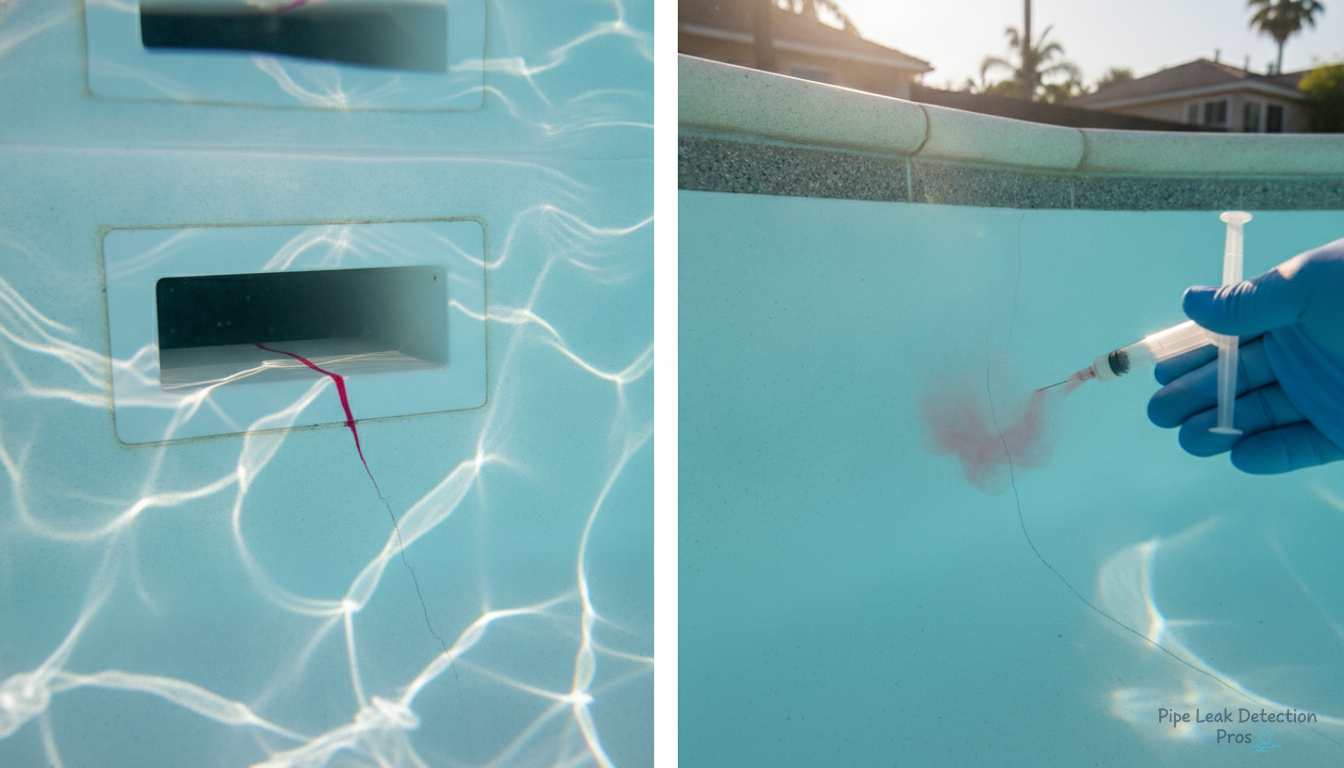
Two of the Most Common Pool Leaks — Both Frequently Missed
When Sherman Oaks homeowners notice their pool losing water, attention often jumps immediately to underground plumbing or equipment pad connections. These are certainly common culprits — but two other leak sources are responsible for a significant share of pool water loss in the area: skimmer failures and shell cracks. Both can be subtle in the early stages, both are frequently mistaken for evaporation, and both can cause compounding structural damage if left unaddressed.
At Pipe Leak Detection Pros, our complete pool leak detection assessments include thorough dye testing and visual inspection of skimmer components and shell surfaces — because finding the right leak source on the first visit is the only way to recommend the right repair.
Why Skimmers Are a Prime Leak Location
The skimmer is the rectangular opening in your pool wall that draws surface water into the filtration system. It's a simple-looking component, but it represents one of the most mechanically vulnerable spots on any pool — and it's where we find leaks with surprising regularity in pools throughout Sherman Oaks, Encino, and Van Nuys.
Here's why skimmers fail so commonly:
- Bond line separation — The junction between the plastic skimmer body and the surrounding gunite or concrete shell is one of the weakest points on an older pool. Ground movement, temperature cycling, and age cause this bond to crack, creating a gap that allows water to escape steadily around the skimmer.
- Degraded throat gaskets — The rubber gasket sandwiched between the skimmer faceplate and the pool wall provides a watertight seal. Over time — particularly in pools that are 10 to 15 years old or older — this gasket dries out, compresses, or tears, breaking the seal and allowing water to leak behind the skimmer body.
- Cracks in the skimmer body itself — The plastic skimmer housing can crack from freeze-thaw stress (rare but possible in the Valley's occasional cold nights), chemical imbalance, or physical impact. Even a hairline crack in the lower half of the skimmer body can allow hundreds of gallons to escape each week.
- Failed putty around the faceplate — Plaster putty used to seal the faceplate perimeter deteriorates over time and may not be replaced during routine pool maintenance, leaving gaps that allow slow seepage.
How Dye Testing Confirms a Skimmer Leak
The definitive method for confirming a skimmer leak is dye testing — and it's one of the cleanest, most visually compelling diagnostics in pool leak detection. Our skimmer leak detection and repair process works as follows:
- The pool pump is turned off so the water is completely still.
- A small amount of non-toxic, pool-safe dye is introduced near the skimmer throat, the faceplate perimeter, any visible cracks in the skimmer body, and the return fitting nearby.
- If a leak is present, the dye stream is drawn toward the defect by the pressure differential — revealing the exact point of water entry with a thin, unmistakable colored trail.
- Our technicians photograph the dye behavior at each tested location and document all findings in a written report.
This process is entirely non-destructive, takes a fraction of the time of exploratory excavation, and provides a clear visual record that is useful both for repair planning and for homeowner insurance claims where applicable.
Shell Cracks: Cosmetic vs. Active Leaks
Not every crack visible in a pool's interior surface is a problem — but some are. Understanding the difference requires more than a visual scan, and it's one of the most common points of confusion for pool owners and even for some general pool service technicians.
Pool shell cracking falls into two broad categories:
- Cosmetic surface crazing — Fine, shallow cracks in the plaster surface that do not penetrate through to the gunite or concrete shell beneath. These are extremely common on plaster surfaces older than 10 years and do not allow water to escape. They are a cosmetic issue to be addressed at the next replastering, not an active leak.
- Structural cracks with active water loss — Cracks that penetrate through the plaster and into the shell substrate, or that follow stress lines at corners, steps, or the bond beam, can allow measurable water loss. These require repair before any new finish materials are applied.
Our pool shell crack detection service uses dye testing on every suspect crack to distinguish between these two categories definitively. Each crack is tested with the pump off, and the dye's behavior — whether it drifts away from the crack undisturbed or is drawn into it — tells the full story. Every active crack is documented with photographs and measurements, and every passive cosmetic crack is noted as such, so you only invest in repairs that are genuinely needed.
Why Sherman Oaks Pools Are Particularly Vulnerable to Shell Cracking
The San Fernando Valley's geology and climate create conditions that accelerate pool shell cracking compared to other parts of Southern California:
- Seismic activity — The Valley sits in a seismically active region. Even modest ground movement during minor earthquake events can initiate or extend cracks in a pool shell that has already been weakened by age or chemical erosion.
- Clay soil behavior — Clay soils beneath Sherman Oaks and nearby communities like Tarzana and Reseda expand significantly when saturated and shrink as they dry. This cycle places repeated lateral stress on pool shells, particularly at corners and at the bond beam where the shell meets the coping.
- Deferred replastering — Many pools in older Sherman Oaks neighborhoods have plaster surfaces well past their 15-to-20-year service life. Thinning plaster is far more susceptible to cracking from the stresses described above.
The Cost of Waiting: What Unresolved Skimmer and Shell Leaks Do Over Time
A small skimmer leak or a single active shell crack may seem like a minor nuisance — a little extra water to replace, a slightly higher bill. But the downstream consequences of delaying detection and repair are far more serious:
- Water escaping through a skimmer or shell crack saturates the surrounding soil, which in clay-heavy Valley soils leads to expansion and soil movement that can push against the pool shell and accelerate cracking.
- Saturated soil beneath a concrete pool deck causes the deck to heave, sink, or crack — sometimes requiring partial or full deck replacement.
- In extreme cases, chronic water loss through a shell leak can compromise the structural integrity of the gunite or concrete shell itself, turning a repair costing hundreds of dollars into one costing tens of thousands.
Our complete pool leak detection service in Sherman Oaks addresses skimmer inspection, shell crack assessment, and plumbing pressure testing as part of a single comprehensive diagnostic — so no leak source is missed and no repair is deferred until the problem has grown.
Serving Sherman Oaks and the Surrounding Valley
Pipe Leak Detection Pros provides skimmer leak detection, shell crack assessments, and complete pool leak diagnostics throughout Sherman Oaks and neighboring communities including Studio City, North Hollywood, Encino, and Van Nuys. We are available seven days a week from 8:00 AM to 6:00 PM.
If your pool is losing water and you're not sure where to start, call us at (213) 455-5332 or reach out by email at [email protected]. We'll identify the source — whether it's a skimmer gasket, a shell crack, or something deeper — and give you a clear, documented path to a dry pool and a lower water bill.
Confirm Availability
Call +12134555332 or fill out our online form for a free, no-obligation quote.
Request Free Quote