The Hidden Threat Beneath Your Pool Deck
Of all the places a pool can leak, underground plumbing lines are the most difficult to detect and the most damaging when left unaddressed. The return lines, suction lines, main drain pipes, and cleaner lines buried beneath your pool deck are invisible by design — and when one of them develops a crack or a joint separation, the water escaping into the surrounding soil leaves almost no trace at the surface until significant damage has already occurred.
Homeowners across Sherman Oaks, Encino, and Van Nuys often discover underground plumbing leaks only after noticing a soft or sunken patch of lawn, a section of pool deck that has begun to crack or heave, or a water bill that has inexplicably doubled. By that point, the soil beneath the deck may have been saturating for months.
Why Underground Pool Plumbing Fails
Pool plumbing is designed to last for decades, but several factors common to the Los Angeles area accelerate deterioration:
- Seismic activity — Even minor earthquakes and ground tremors can shift buried PVC pipes enough to separate glued joints or crack elbows and tees under the slab.
- Clay soil expansion and contraction — The San Fernando Valley's clay-heavy soils swell when wet and shrink when dry, placing lateral stress on buried plumbing that compounds over years.
- Age of original installation — Many Sherman Oaks pools were built in the 1960s through 1980s, and the PVC plumbing installed then is now approaching or past its expected service life.
- Tree root intrusion — Established trees common in neighborhoods like Studio City and Tarzana can send roots into cracked plumbing joints, enlarging small failures into significant leaks.
- Improper original installation — Poorly glued fittings, undersized pipe, or shallow burial depths can all lead to premature failure.
What Pressure Testing Actually Involves
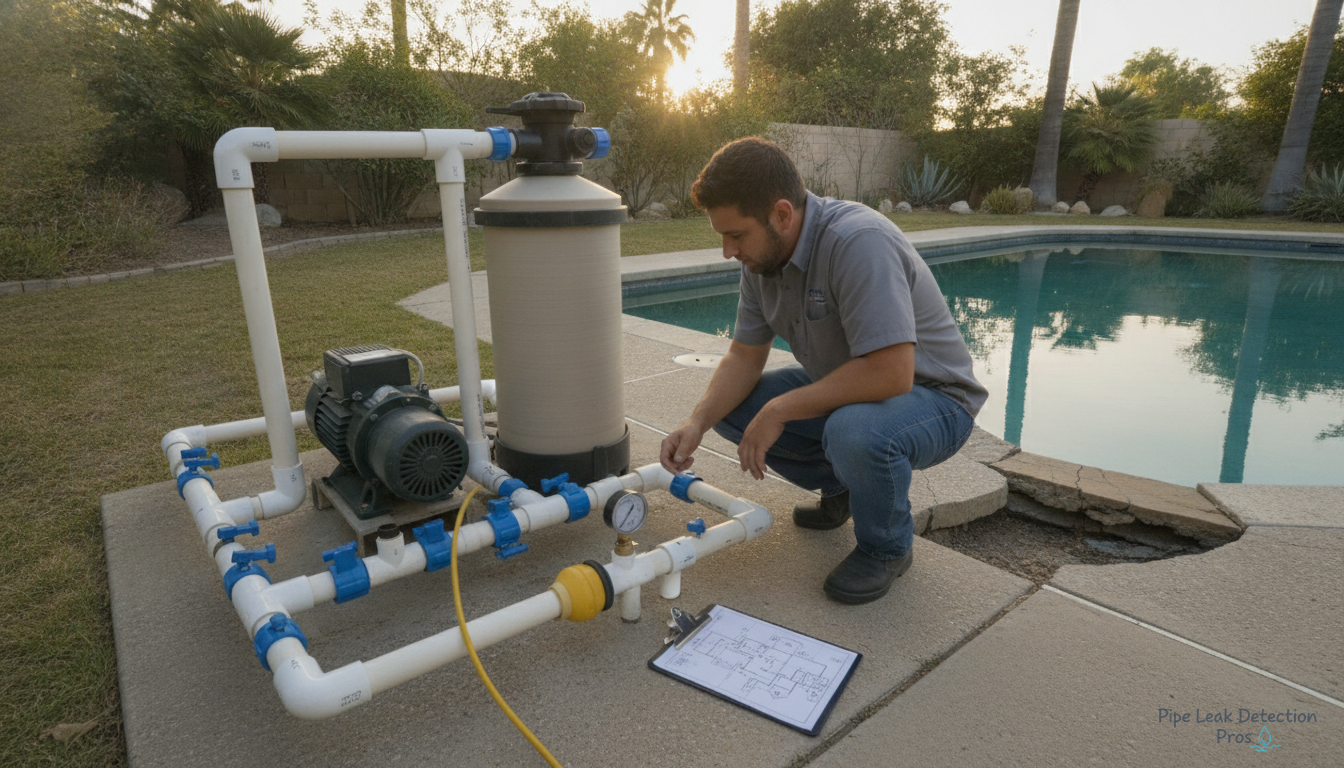
Pressure testing is the standard — and most reliable — method for diagnosing underground pool plumbing leaks. Our pressure testing and leak isolation process works by isolating each plumbing circuit individually and introducing a controlled amount of compressed air or nitrogen at the equipment pad.
Here is the step-by-step process our technicians follow:
- Plug all pool openings — Inflatable or mechanical test plugs are inserted at each return jet, skimmer port, and main drain opening at the pool wall to isolate the plumbing from the pool water.
- Pressurize one circuit at a time — Each line — returns, suction, main drain, cleaner line — is pressurized individually using a calibrated gauge and air or nitrogen source connected at the equipment pad.
- Monitor for pressure decay — A line in good condition holds its pressure steadily over the test interval. A line with a crack, separated joint, or failing fitting loses pressure measurably, flagging it as compromised.
- Acoustic pinpointing — Once a failing line is identified, our technicians use ground-microphone listening equipment above the deck surface to listen for escaping air or water pressure and mark the precise leak location — often within inches.
- Written findings report — Every circuit tested receives a pass or fail notation, and the report includes a hand-drawn diagram of any leak locations marked on the deck or yard surface.
What Pressure Testing Reveals That Visual Inspection Cannot
A visual inspection of your pool's equipment pad, returns, and skimmers can identify obvious drips and surface stains — but it cannot tell you what is happening three feet below your concrete deck. Pressure testing is the only way to confirm whether buried plumbing is intact or compromised, and it does so without removing a single paver or core-drilling a single hole.
Our pool plumbing leak detection service combines pressure testing with acoustic ground-listening to deliver the precise leak location before any repair crew lifts a saw. This matters because the cost of targeted excavation — cutting a small access hole at a confirmed leak point — is a fraction of the cost of removing large sections of coping, tile, and decking to search blindly for a leak source.
Before You Renovate: Why Pre-Construction Pressure Testing Is Essential
One of the most important — and most overlooked — applications of pool pressure testing is pre-renovation clearance. If you are planning to replaster, retile, or replace your pool deck, verifying that all underground plumbing circuits are leak-free before the new surfaces go in is critical.
Discovering a leaking underground line after new plaster has been applied means tearing out finish work to excavate and repair the pipe — and then replastering again. The cost of a pre-renovation pressure test is negligible compared to the expense of that scenario. We regularly help homeowners in Reseda, North Hollywood, and throughout the Valley avoid exactly this situation before major pool renovation projects begin.
Equipment Pad Leaks vs. Underground Plumbing Leaks: Understanding the Difference
Not every plumbing leak at the equipment pad is an underground plumbing leak. Union fittings, pump lid o-rings, and valve gaskets at the surface of the equipment pad are also common sources of water loss — and they are often much simpler to identify and repair. Our pool equipment pad leak detection service addresses these above-grade plumbing components separately, ensuring that every segment of your pool's plumbing system is evaluated before a diagnosis is finalized.
A thorough assessment combines both equipment pad inspection and full-circuit pressure testing — giving you a complete picture of your pool plumbing's integrity from the pump housing all the way to the buried return jets.
Schedule Your Pool Pressure Test in Sherman Oaks
If your pool is losing water, your deck is showing new cracks, or you're planning a renovation and want plumbing clearance first, Pipe Leak Detection Pros is ready to help. We serve Sherman Oaks and the greater San Fernando Valley — including Van Nuys, Encino, and Studio City — with appointments available seven days a week, 8:00 AM to 6:00 PM.
Call (213) 455-5332 or email [email protected] to book your pressure test today.
Confirm Availability
Call +12134555332 or fill out our online form for a free, no-obligation quote.
Request Free Quote